Radon Fan Replacement in Lafayette, CO
Fan gone quiet? Manometer flat? Retest came back higher than last time? We diagnose the whole system before we quote a fan, so you are not paying to replace the wrong part.
Get a Free Diagnostic
One of the owners will get back to you.
How Do You Know If Your Radon Fan Has Failed?
Three signs tell you a radon fan has failed: no hum when you put your hand near the pipe, a manometer reading that sits flat and level, and a radon retest that comes back higher than your last one. Radon fans run nonstop for years with no off switch and no seasonal break, so eventually they wear out. Nothing was done wrong.
Most people do not notice a dead fan right away. They walk past the attic hatch or step outside and realize it is quiet. Or they are selling the house and the retest comes back higher than the original.
The fan is the only part of a mitigation system that wears out on a predictable timeline. The piping, the slab seal, and the sub-slab layout underneath do not degrade the same way. If the system has gone silent, the fan motor is the usual reason.
Read the manometer in ten seconds. That is the small U-shaped tube mounted on the system pipe, and it shows the pressure the fan is pulling underneath the house. If the fan is working, the liquid sits uneven. If the fan has failed, the liquid levels out. Worth a look every few months.
- No hum Hand near the pipe in the attic or garage and you hear nothing.
- Flat manometer The liquid in the U-tube sits level, showing no pressure difference.
- Higher retest A recent test reads higher than results from when the system worked.
- Rust or cracks Cracking, corrosion or moisture around the fan housing.
- Warm, not moving Warm to the touch but no air moving, which means the motor is straining.
Is It Always the Fan, or Could Something Else Be Wrong?
Not always. If the fan is silent or will not turn, it is almost certainly the fan. But if the fan runs normally and radon levels are still climbing, the problem is usually somewhere else in the system: a cracked pipe joint, a loose slab penetration, a torn vapor barrier, or a system that was never sized for a later basement addition. Replacing the fan would not fix any of those.
- Usually the fan Loud vibrating or grinding against the pipe. A fan that will not come on or will not turn. Those point straight at the motor.
- Usually not the fan A fan running fine with high follow-up results. That is a leak in the pipe, a barrier that is not sealing, or a system undersized after a basement addition.
The fan's only job is keeping pressure below the slab negative so radon in the soil is not drawn up into the house. Anything that breaks that pressure looks like a failing fan from the outside. So when someone calls about a noisy or silent fan, a replacement is not automatic. We go through the full run first.
Sometimes it turns out the penetration through the slab needs re-sealing. There is a gap, and air is getting in there. We would rather find that first than replace a fan and leave the real problem in place. If the whole setup is past saving, that becomes a conversation about a complete radon mitigation system instead. The EPA guide to radon reduction covers what a working system is supposed to do.
If the system is under ten years old with no airflow issues or unusual noise, the fan may not be finished yet. The on-site diagnostic is free, so it costs nothing to find out which part actually failed.
What Happens During a Radon Fan Replacement?
We confirm the fan is the actual problem, cut it out of the PVC run, check and repair the outlet if needed, and install the new fan in the same orientation as the old one. Then we verify the manometer is pulling negative pressure again and check for leaks at the fan and pipe joints. The pipe, the slab seal, and the vent all stay untouched.
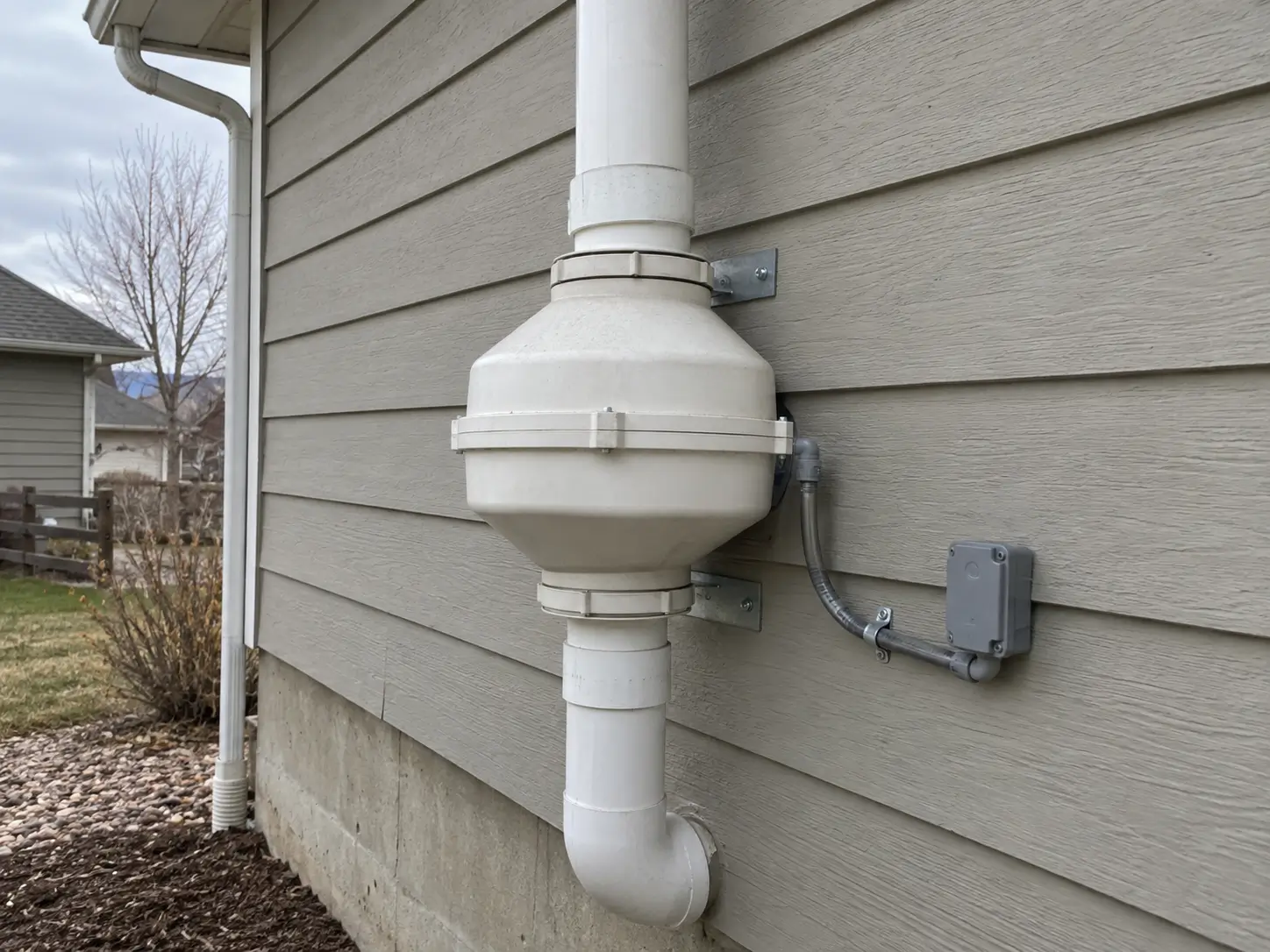
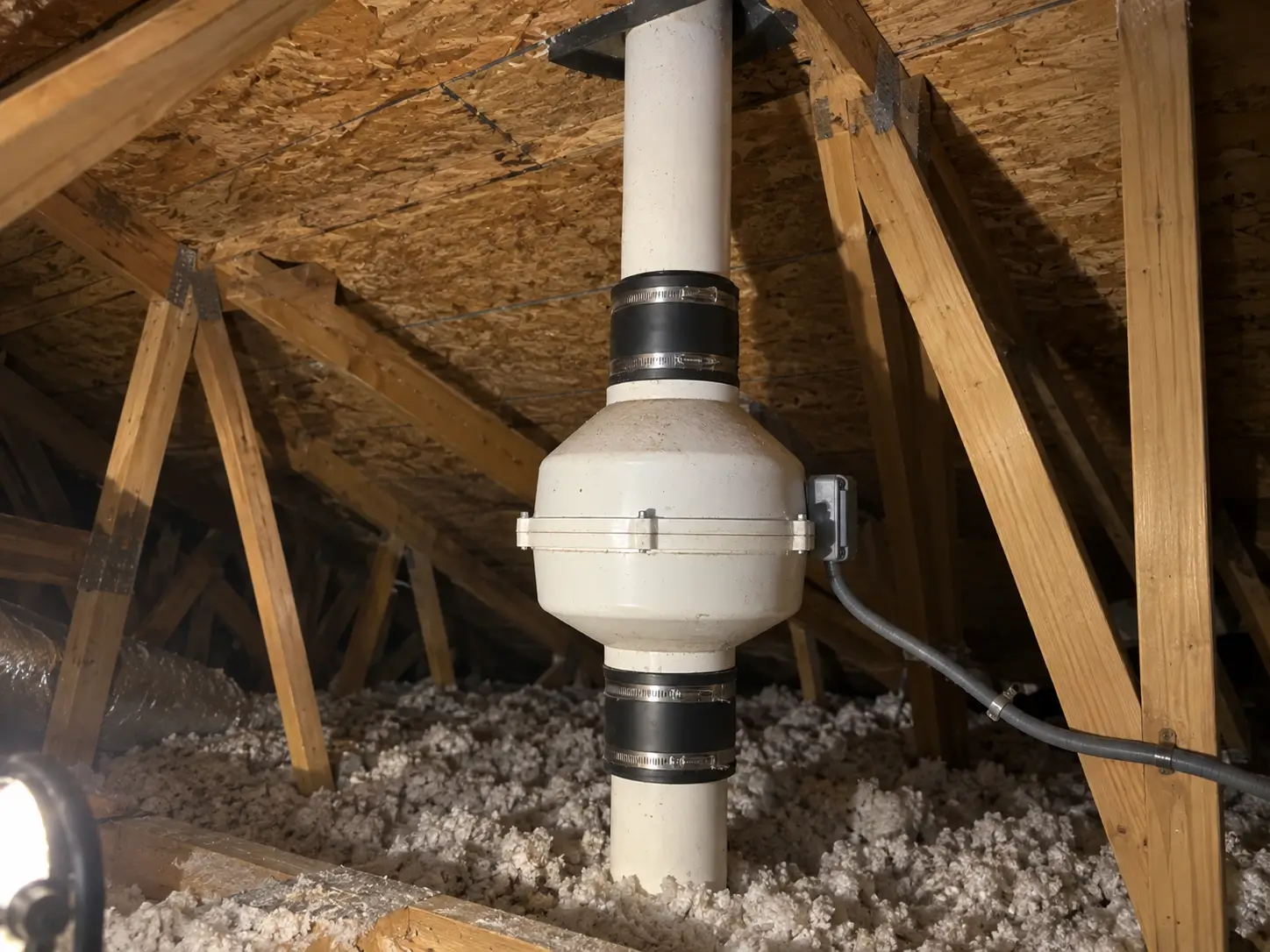
A fan swap is far simpler than a new system. Nothing gets drilled, no new pipe run goes in, and finished walls stay closed. The fan is the only component creating negative pressure, so it is the only part being replaced. Fans are usually mounted in the garage, the attic, or on an exterior wall.
- Confirm it is the fan Not a cracked pipe or a loose seal somewhere else in the run.
- Cut the old fan out Removed from the PVC run. Nothing else gets touched.
- Check the outlet Repaired or replaced if the wiring is not sound. Older outlets corrode.
- Install the new fan Same orientation as the old one, coupled with seals rated for attic or outdoor conditions.
- Verify the pressure Power restored, manometer checked for negative pressure, joints checked for leaks.
Orientation matters more than people expect. Radon fans only move air one direction, and there is an arrow on the housing showing which way it faces. Installed backwards, the system pulls air the wrong way.
Outlets behind older fans corrode over time, and some were installed incorrectly to begin with. If the outlet is burnt, corroded, or wired wrong, it gets fixed as part of the job rather than left for someone else.
Find Out Which Part Actually Failed
The on-site diagnostic is free. We check the whole run before quoting anything, so you are not paying to replace a part that was working fine.
What If the Fan Is Behind a Finished Basement Wall?
We open the soffit or false wall, replace the fan, and patch the finish work back so it looks the way it did. Plenty of Lafayette homes have basements finished years after the slab was poured, with the radon pipe hidden inside a soffit or a fake wall.
Where the fan sits changes the job more than anything else. Because of our general contracting background, the finish work gets handled in-house rather than left for you to arrange.
- Garage or exterior wall Quick access, no finish work involved. The simplest version of this job.
- Soffit or false wall The pipe is boxed into finished basement framing. That gets opened cleanly and closed back up.
- Crawl space Fan is typically outside or above the barrier. Working room is limited, so access takes longer.
A torn barrier means a new fan will not fix it. On a sealed vapor barrier system, the barrier gets inspected while we are in there. If it has lifted or torn, soil gas simply goes around it no matter how new the fan is.
If there is no outlet where the fan needs power, we wire one in. An extension cord is not a fix. We ask about the setup before showing up with a ladder, so there are no surprises on either side.
What Changes the Cost of a Radon Fan Replacement?
Access and labor, mostly. A fan on a garage wall is a quick swap. A fan in a tight attic, above a roofline, or behind a finished basement soffit takes longer, and labor time is the largest part of the bill. Whether the existing outlet works, and whether any pipe needs repair, moves it too. Not every replacement is a like-for-like swap.
- Access height Roof, attic, exterior wall or crawl space. Labor time is the largest part of the bill.
- Outlet condition Whether a working outlet is there already or one has to be wired in.
- Pipe repair Whether any of the existing run is cracked or failing and needs work.
- Finish work Whether a soffit or false wall has to be opened and rebuilt to reach the pipe.
- Roofline Roof slope and height if the fan sits above the roofline.
We inspect the setup on site, including getting into the attic if that is where the fan lives, then give you one flat rate. No quotes over the phone based on guesses. No open-ended hourly billing for attic work. The price quoted on site is the price at the end of the job.
Radon Fan Replacement Questions
-
How long does a radon fan last?
Radon fans typically run for years before wearing out, and they run continuously with no off switch and no seasonal break. That constant operation is why the fan is the one component of a mitigation system that fails on a predictable timeline. The piping, slab seal, and sub-slab layout do not degrade the same way. A fan that has gone silent has usually reached the end of its service life.
-
Can I replace a radon fan myself?
It involves cutting into the PVC pipe run, wiring at the outlet, and often working at height in an attic or on an exterior wall. The fan also has to be installed in the correct orientation, since radon fans only move air one direction and a backwards install pulls the wrong way. It is also worth confirming the fan is the real problem before replacing it.
-
My radon fan is making a loud humming noise. Is that normal?
A low, steady hum is normal and means the fan is running. New grinding, rattling, or vibrating against the pipe is not, and usually means the motor is wearing out. A fan that is warm to the touch but not moving air is straining. Any of those is worth having looked at before the fan fails completely and radon levels start climbing.
-
Do I need to retest for radon after replacing the fan?
Retesting confirms the system is back to doing its job, and it is the only way to know your levels actually came down. We install and service systems but do not perform radon testing, so you would order a test kit or use a continuous monitor. The manometer tells you the fan is pulling pressure. A test tells you what the levels are.
-
Will you replace a fan on a system another company installed?
Yes. Fan replacement does not depend on who installed the original system. We check the full run first, including the pipe joints, the slab penetration, and the vapor barrier if it is a crawl space, so the right part gets replaced. If a soffit or false wall has to be opened to reach the pipe, we handle the finish work too.
-
What if the fan is not the problem?
Then replacing it would not help, and we would tell you that. A fan running normally with radon levels still climbing usually points to a cracked pipe joint, a loose slab penetration, a torn vapor barrier, or a system never resized after a basement addition. The on-site diagnostic is free, so finding out which it is costs nothing.
Radon Fan Replacement in Lafayette, CO
One of the owners picks up. Tell us what the fan is doing and where it sits, and we will set up a time to come look.
Open seven days · 6:00 AM – 8:00 PM
No system yet? See how a new install works.